Posts Tagged ‘Stained Glass’

Art of Light

Posted on: February 12th, 2026 by Abbey_admin

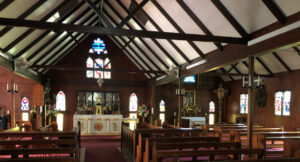
Coming into the Abbey Church in the late afternoon sun is like walking into a rainbow of colour.

Probably nowhere else in Australia can a visitor walk into a church and find themselves surrounded by ancient medieval stained glass, that dates back over 650 years.  Stained glass is an art form that relies on light to be seen. And light is an essential element in our spiritual journey.

In the 12th century, Abbot Sugar wrote in France: “Thus sometimes because of my delight in the beauty of the house of God, the multicolour loveliness of the stained glass calls me away from external cares and worthy meditation…. To see myself existing on some level, as it were, beyond our earthly one.

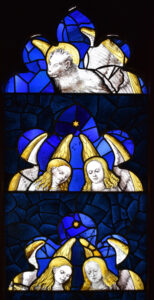
Stained Glass Panel of Angels originally from Winchester Cathedral

Stained Glass Panel of Angels originally from Winchester Cathedral

The Abbey Church contains a large collection of precious fragments from Winchester Cathedral, made in 1490-1510, and largely destroyed by Puritan fundamentalists in the English Civil War.  Set in dark blue glass, golden-haired angels look down as they have done for over 500 years.

There are also a series of heraldic windows dating from the mid-14th century with coats of arms that echo the deeds of knights and princes.  They come from the Church of the Holy Trinity at Ettington, in England, the home of the famous Shirley family.
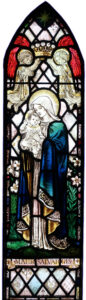
Stained Glass panel depicting the Virgin Mary holding the Baby Jesus by Karl Parsons

Virgin Mary with Baby Jesus by Karl Parsons

We also have several Gothic Revival windows, including a wonderful panel of St Michael the Archangel, holding the scales of judgment, probably by the famous artist, Henry Holiday (1839-1927), who worked for the firm of James Powell & Sons of Whitefriars in London.

Another lovely window represents the Virgin Mary holding the Christ Child, surrounded by lilies.  It is by Karl Parsons (1884-1934), a brilliant artist who made windows for Canterbury Cathedral.

A twelve year conservation program from 2008 – 2020 ensured the preservation of these beautiful windows for future generations. In 2021, the Abbey Museum published a catalogue entitled Glorious Glass: Stained Glass in the Abbey Museum Collection, written by the Museum’s Senior Curator, Michael Strong.

The Abbey Museum also offers guided tours of the stained glass in the Abbey Church on Tuesdays and Thursdays 11.00 am, or for groups by appointment.

Tags: , ,
Posted in Abbey Church, Uncategorised | No Comments »

Posts Tagged ‘Stained Glass’

Stained Glass: Restoring the Glory

Posted on: March 25th, 2016 by Abbey_admin

Over the past 10 years, the Abbey Museum has been campaigning to raise money for the conservation of the historical stained glass in the Abbey Church.  In total there are 48 windows that needed attention due to deteriorating lead work (the strips of lead that hold the small pieces of glass together) cracks in the glass or buckling. In total $163,000 needed to be raised. To some that may not be considered a lot of money, but to a small organisation it seemed a huge task.

But with the support of many generous donors who sponsored individual windows, fundraising activities and special grants we have nearly achieved our goal. On Monday 21st March, four of the final seven panels were removed for conservation by stained glass specialists Gerry Cummins and Jill Stehn.  These included two pre-Raphaelite panels depicting St Hilda and Mary Magdalene and two panels of medieval fragments, one which included a shield from Lincolns Inn in London, a German coat of arms panel,  and the other a sun image.

Stained Glass in the Abbey Church being removed for conservation

Stained Glass in the Abbey Church being removed for conservation

Symbols in Medieval Stained Glass

Stained glass in churches had its origins in the early Middle Ages. Not only were they used as sources of light into the otherwise dark buildings, they were also used educate the otherwise illiterate populous. Stained glass is the only medium that requires transmitted light in order to be appreciated.  It readily became identified with the light of God.   Our St Hilda panel, although much later in date, follows the medieval tradition of using symbols to identify the individual depicted. St Hilda holds a crosier which indicates she was an abbess of a religious community. She also holds a representation of her abbey at Whitby, in north eastern England.  Finally there is a small shield at the bottom that includes what looks like three curled up snakes. In a similar vein to the legend of St Patrick chasing all the snakes out of Ireland, St Hilda was supposed to have turned the snakes in Whitby to stone.  What is remarkable about this is that the cliffs around Whitby are well known as a source of fossilised ammonites, which look like curled snakes turned to stone.

Stained Glass panel depicting St Hilda removed from the Abbey Church for Conservation

Stained Glass panel depicting St Hilda removed from the Abbey Church for Conservation

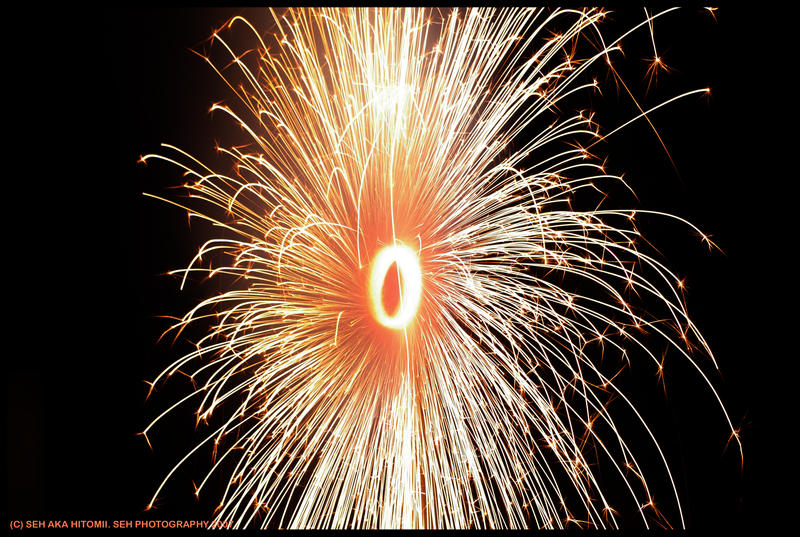
Other symbols used in the stained glass windows in the Abbey Church depicting saints includes a palm leaf, representative of an individual who was martyred – the palm of victory; St Cecilia considered to be the patron saint of musicians holds a very early pipe organ; and then there is St Catherine who holds a wheel. Legend tells us St Catherine, who came from Alexandria in Egypt was tortured on a wheel. Incidentally, the Catherine wheel, popular in any fireworks display was named after the St Catherine tradition.

These windows and many others can be seen in the Abbey Church. The Abbey Museum staff take guided tours  each Tuesday and Thursday at 11.00 am. Why not visit to see this amazing heritage in stained glass. Michael Strong is giving a talk on the stained glass heritage on a Sunday in late May.  Watch this space for details or follow us on Facebook.

Tags: , ,
Posted in Abbey Church | No Comments »